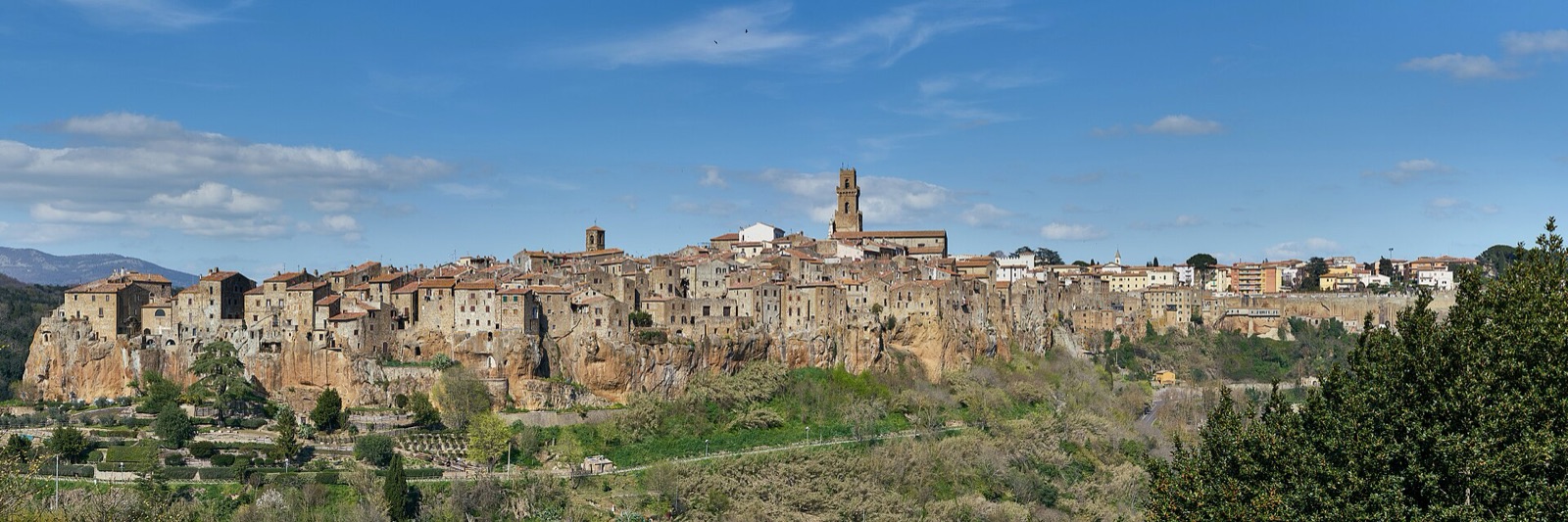
Hill towns in Tuscany: how to choose without trusting the rankings
Lists of "the most beautiful places in Tuscany" line up villages that are hours of driving apart. Monteriggioni and Pitigliano sit at opposite ends of half the region, and the same is true of Barga and Poppi. That is why the borghi (the hill towns and villages) on this page are grouped by area: pick the area according to where you are staying, then pick the village. As for booking, in the villages almost everything is paid at the door. If you don't drive, the only thing worth booking is a tour from Florence, and you'll find the most useful ones at the bottom of the page.
Three questions before you set off:
- Do you have a car? Without one, only Certaldo Alto and the villages covered by tours from Florence, Monteriggioni first among them, are really convenient. The rest can be done on Autolinee Toscane buses, but often with changes and only a few services a day.
- Are you looking for a monument or an atmosphere? Vinci and Poppi have a museum or a castle that justifies the trip on its own. San Quirico, Sovana and Barga are mostly about wandering on foot.
- Do you care about the label? "Borghi più belli d'Italia" (the most beautiful villages of Italy) is a private club with a precise list. Many famous villages are not members, and they are none the worse for it.
If you're looking for the Tuscan cities instead (Siena, Lucca, Pisa, Arezzo), they have their own pages: start from the 10 things to see or from the map.
Which ones really carry the label
Two labels circulate in guidebooks and are often confused. The Borghi più belli d'Italia club publishes a list by region. The Touring Club's Bandiera arancione (orange flag) rewards small towns for the way they welcome visitors, and the Touring Club reviews its awards from time to time: the column below reflects the latest list available, so check it again if the label matters to you.
| Village | Area | Borghi più belli d'Italia | TCI Bandiera arancione |
|---|---|---|---|
| Monteriggioni | Siena area | no | yes |
| Certaldo Alto | Valdelsa | no | yes |
| San Quirico d'Orcia | Val d'Orcia | no | no |
| Anghiari | Valtiberina | yes | yes |
| Poppi | Casentino | yes | no |
| Barga | Middle Serchio Valley | yes | yes |
| Vinci | Montalbano | no | yes |
| Collodi (Pescia) | Valdinievole | no | yes |
| Peccioli | Valdera | no | yes |
| Pitigliano | Tufa Maremma | yes | yes |
| Sovana (Sorano) | Tufa Maremma | yes | Sorano yes |
| Massa Marittima | Colline Metallifere | no | yes |
Watch out for a common mix-up: the Borghi più belli list includes Castiglione di Garfagnana, not Castiglione della Pescaia on the coast.
Valdelsa, the Siena area and Val d'Orcia: the easiest from Florence
Monteriggioni
The ring of walls built by the Sienese between 1213 and 1219 is about 570 metres long, with 14 towers and two gates. Dante used it as an image in the Inferno (Canto XXXI): the giants standing around the pit are like the towers with which "Montereggion... si corona", the towers that crown Monteriggioni. The village inside the walls is small: including the museum, a stop of a couple of hours is enough.
The €5 ticket (reduced €3.50 for over-65s, groups and pilgrims with a credential; free under 8) covers the wall walk, the Monteriggioni in Arme armour museum, where you can touch and try on the replicas, and the archaeological museum at Abbadia Isola. At present only one section of the southern wall walk is open, so don't expect to go all the way round. Current opening hours: 10:00–13:00 and 14:00–18:45, with changes during the medieval festival in July.
Without a car: Monteriggioni lies on the Via Francigena between Colle/San Gimignano and Siena, and walkers reach it on foot. For everyone else, the simplest option is a tour from Florence that combines it with Siena and San Gimignano: see Siena and San Gimignano.
Certaldo Alto
The upper town of Certaldo is the town of Giovanni Boccaccio, who lived and died here. You can visit Boccaccio's House and the Palazzo Pretorio. Tickets from the Ente Boccaccio: €7 for Casa Boccaccio + Palazzo Pretorio (reduced €6), €9 if you add the Museum of Sacred Art. From April to October it opens every day 10:00–13:00 and 14:30–19:00; in winter it closes on Tuesdays and the hours are shorter.
Without a car: this is the easiest village on the whole page. Certaldo is on the Florence–Empoli–Siena railway; from the station, in Certaldo Basso (the lower town), the funicular leaves from Piazza Boccaccio and climbs to Porta Alberti, usually every 15 minutes until late evening in season. The ticket costs just over a euro: check the fare on the website of Autolinee Toscane, which runs it. Bus 128 to San Gimignano also leaves from Certaldo, which is handy if you want to do both villages in a day.
San Quirico d'Orcia
The most picture-postcard village in the Val d'Orcia, and less crowded than Pienza and Montalcino. Free to visit are the Horti Leonini, a formal Italian garden from the 16th century, and the Collegiata dei Santi Quirico e Giulitta. The village is a stage on the Via Francigena, and nearby stands the chapel of the Madonna di Vitaleta with its cypresses, one of the most photographed views in the valley.
Without a car: difficult. Val d'Orcia tours from Florence pass through the area, but check the itinerary to see whether San Quirico is an actual stop or just somewhere you drive through.
Arezzo and around: Valtiberina and Casentino
Two villages to pair with Arezzo and Cortona, if you have a car.
Anghiari
In 1440, on the plain below the town, the Battle of Anghiari was fought: the subject of Leonardo's great lost mural in Palazzo Vecchio. The Museo della Battaglia e di Anghiari is devoted to that day. The village is one of the five on this page that belong to the Borghi più belli d'Italia. Ask about the museum's prices and opening hours before you go.
Poppi
The Casentino is dominated by the Castle of the Conti Guidi, with its Hall of the Battle of Campaldino: the clash of 1289, fought not far away, in which Dante is said by tradition to have taken part. The castle has full-price, reduced and free tickets, but the fares are not published online: email info@castellopoppi.it or call +39 350 1974405 before you go.
Without a car, a day out to Anghiari and Poppi on public transport is long and full of changes: better not to count on it.
Between Florence, Pistoia and Lucca
Vinci
The Museo Leonardiano is split between the Palazzina Uzielli, the Castle of the Conti Guidi (with the terrace on the tower) and the "Leonardo and painting" section at Villa del Ferrale. His birthplace is at Anchiano, a few kilometres uphill, and can be reached on foot along a path through the olive groves.
| Ticket | Full price | Reduced |
|---|---|---|
| Museum + birthplace | €14 | €11 |
| Museum only | €11 | €9 |
| Birthplace only (with "Leonardo and painting") | €7 | €5 |
Reduced for over-67s, young people aged 6–18 and university students up to 25; free under 6. From April to 1 November the museum opens 09:30–19:00; from November to February it is closed on Tuesdays.
Collodi
Carlo Lorenzini took his pen name from his mother's village, and today Collodi lives off Pinocchio: the Parco di Pinocchio and the Giardino Garzoni, a Baroque garden with a Butterfly House. It is the right trip if you have children. The official price list, combined tickets and opening hours are on the page about caves and parks.
Barga
In the Middle Serchio Valley, above Lucca. At the top of the town stands the Romanesque cathedral of San Cristoforo; in nearby Castelvecchio Pascoli is the house of the poet Giovanni Pascoli. Barga also has strong ties with Scotland, where many people from the town emigrated. From Lucca it is the most natural trip towards the Garfagnana, but you need a car.
Valdera: Peccioli
The most unusual case: a village in the Pisan hills that has become an open-air museum of contemporary art, the MACCA, with more than 70 works spread across the main village and its hamlets. The best known are the Giganti (Giants) by the Naturaliter group, four figures up to about 9 metres tall on the viewpoint of the Triangolo Verde. There are also wall drawings by David Tremlett and the amphitheatre at Fonte Mazzola. The works are scattered across the area: to get around them, and to get there, you need a car.
The tufa Maremma: Pitigliano, Sovana and Sorano
Three villages a few kilometres from one another, and far from everything else: from Florence it is a long drive. It makes sense to stay overnight in the area, perhaps combining it with the hot springs of Saturnia.
Pitigliano
The town looks as if it were carved out of the tufa cliff, and in part it is: cellars and Etruscan tombs are dug out beneath the houses. From the 16th century it was home to a Jewish community important enough to earn it the name Piccola Gerusalemme, Little Jerusalem. The synagogue, built in 1598, can be visited along with the underground rooms: the oven for unleavened bread, the kosher butcher's and the kosher wine cellar. The Jewish cemetery can also be visited.
Opening hours: from April to October, Sunday–Friday 10:00–13:00 and 14:30–18:00; from November to March 10:00–12:30 and 14:30–16:30. Closed on Saturdays and on Jewish holidays. A full-price ticket is usually €8 (reduced €5), paid on site: online sales are not yet available. Information on 0564 614230.
Sovana and Sorano
Between the three villages run the Vie Cave, Etruscan roads cut deep into the tufa: you walk them on foot, in the open air and for free. Sovana, a hamlet of Sorano, is tiny and belongs to the Borghi più belli d'Italia; around it lie the Etruscan necropolises of the Città del Tufo archaeological park, with the Tomba Ildebranda (check the ticket price on site). Sorano, rougher around the edges, is dominated by the Fortezza Orsini.
Colline Metallifere: Massa Marittima
The sloping Piazza Garibaldi and the cathedral of San Cerbone at the top of a flight of steps make one of the most successful medieval set pieces in the region. This is also where you'll find the Albero della Fecondità (Tree of Fertility), a fresco of a tree hung with phalluses. In May and August the town holds the Balestro del Girifalco, a crossbow contest, and there is a mining museum in town. Here too, it is complicated without a car.
What to book
For the villages themselves there is almost nothing to book: the walls of Monteriggioni, the museums in Certaldo and Vinci and the synagogue in Pitigliano are all paid at the entrance. The problem, if you don't drive, is getting there. This is where tours from Florence make sense, because they solve the transport problem for places that public transport serves badly.
Certaldo, Monteriggioni & Castellina: Day Tour from Florence + Cooking Class
(18 reviews) from €159
Book on Tiqets
Siena, San Gimignano & Monteriggioni: Day Trip from Florence + Wine Tasting
(51 reviews) from €75
Book on Tiqets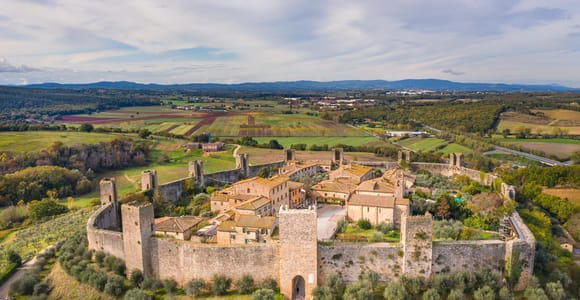
Florence: Monteriggioni & Val d'Orcia Optional Wine Tasting
(299 reviews) from €49.50
Book on GetYourGuide- Certaldo, Monteriggioni and Castellina in Chianti with a cooking class (Tiqets, from €159): the only tour in this selection that goes to Certaldo, with cooking as the centrepiece of the day. It costs more, because you cook your own lunch. More ideas on the page about cooking classes.
- Siena, San Gimignano and Monteriggioni with a tasting (Tiqets, from €75): the classic combination, with Monteriggioni as a short stop. It works if you want to see the walls without devoting a whole day to them.
- Monteriggioni and Val d'Orcia (GetYourGuide, from €49.50): the cheapest way to combine a village near Siena with the landscape of the Val d'Orcia.
Partner prices change often and we check them regularly; the final price is the one you see when you book. To compare all the day trips, see day trips from Florence.
All Tuscany day trips on Tiqets
Mistakes to avoid
- Counting on a full circuit of the walls at Monteriggioni. At present only one section on the southern side is open.
- Going to Pitigliano on a Saturday for the synagogue. It is closed: the town is still beautiful, but you miss the most interesting part.
- Squeezing three areas into one day. Pitigliano and Monteriggioni on the same day mean hours on the road and very little time on foot.
- Trusting labels copied from one website to the next. If the label matters to you, the list to check is the one published by the club.
- Forgetting winter Tuesdays. In Vinci (November–February) and Certaldo (November–March) the museums close on exactly that day.
For more ideas outside the cities: Chianti, Volterra and Elba and the page with all the experiences.