What to book, in short
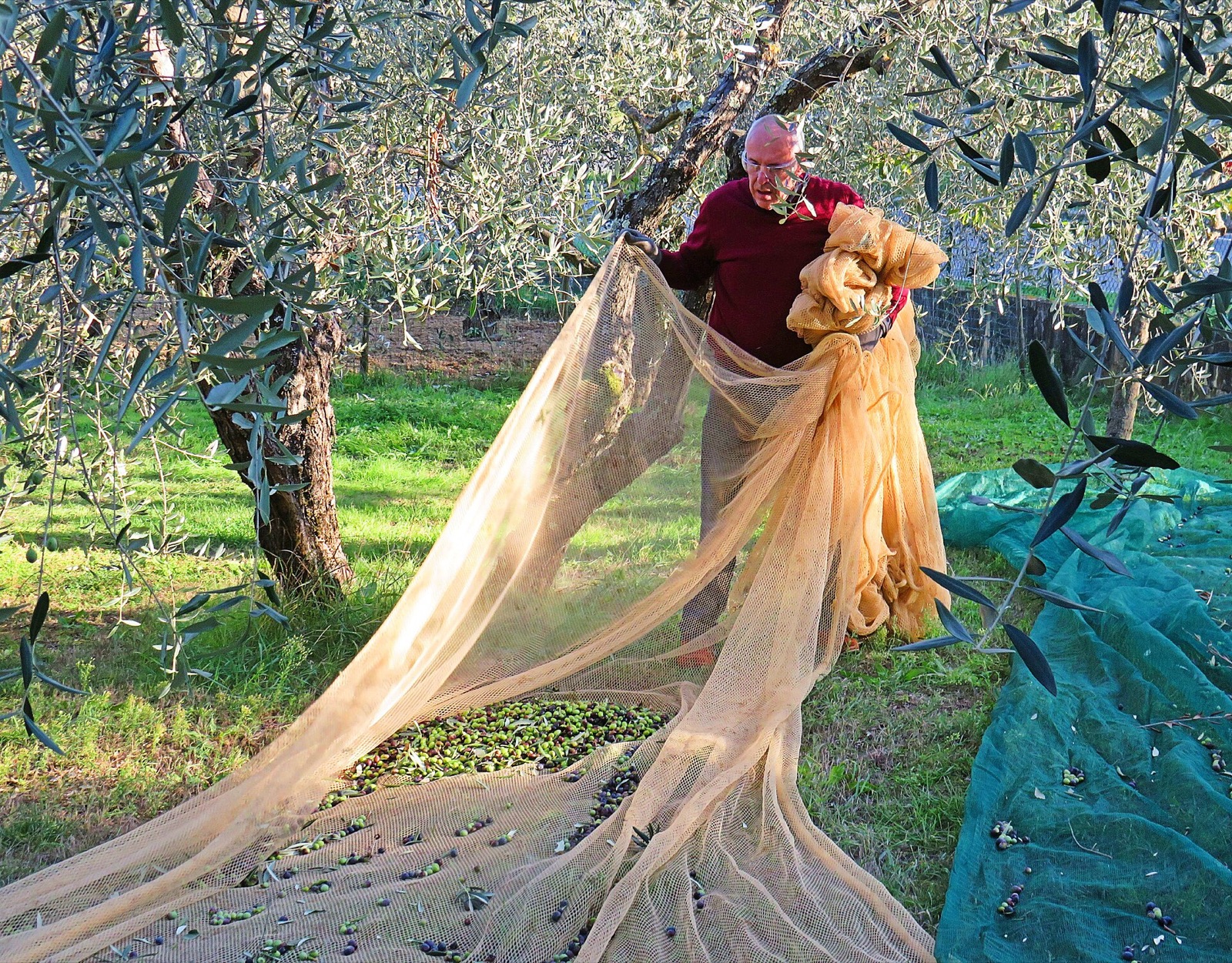
If you are in Tuscany between mid-October and November, book a visit to a working olive mill (frantoio). You will see the olives go into the hopper and the oil come out of the separator, and you will taste it on bread still warm from the oven. It is the real thing, and it is cheap: usually between €20 and €60 per person.
In spring or summer the mill is idle and clean. A guided tasting is still worthwhile, because you learn to tell a good extra virgin oil from a flat one, but the spectacular part is missing. In those months it makes more sense to pair oil with wine, at one of the many estates in Chianti that make both.
If you don't have a car, the simplest option from Florence is the e-bike ride in the hills of Fiesole with an oil tasting. If you are staying near Siena or in the Val d'Orcia, there are family-run mills a few minutes' drive away.
When to go: the harvest and the new oil
- January: not recommended or closed
- February: not recommended or closed
- March: not recommended or closed
- April: not recommended or closed
- May: not recommended or closed
- June: not recommended or closed
- July: not recommended or closed
- August: not recommended or closed
- September: good
- October: best time
- November: best time
- December: good
best time good not recommended or closed
Pressing usually runs from mid-October to November. Tastings take place all year, but you only see a mill at work in autumn. Many towns hold a new oil festival between November and December.
The harvest usually begins in mid-October and carries on through November; in higher areas or in late years it reaches December. The olives must be taken to the mill within a few hours of picking, because the longer they wait, the more aroma the oil loses and the more acidity it gains. That is why in November the mills are at full stretch and estates have less time for walk-in visits: book a few days ahead.
Olio nuovo, the new oil, is the oil of the first few weeks. It is often unfiltered, deep green and with a taste that stings the throat. At that time you will find it in many trattorias on fettunta, and towns hold new oil festivals, usually between November and December. San Quirico d'Orcia, for example, lists its Festa dell'Olio in its calendar of annual events. Dates change every year: check the municipality's website before making plans.
What an olive mill visit is like
A modern olive mill looks more like a small factory than a wine cellar. Visits nearly always follow the same sequence, and last from one to two hours.
- The olives arrive. Crates come in from the fields, sometimes from small local growers who have their own olives pressed and leave with the oil in tins.
- Leaf removal and washing. A machine strips off leaves and twigs, then the olives are washed.
- Crushing. The olives are ground into a paste, stones and all. In old mills this was done by stone millstones, which you will often still see on display like museum pieces.
- Malaxation. The paste is slowly stirred so that the droplets of oil join together. This is where much of the quality is decided.
- Separation. A centrifugal decanter separates the oil from the water and the pomace. The oil comes out green and cloudy: that is the new oil.
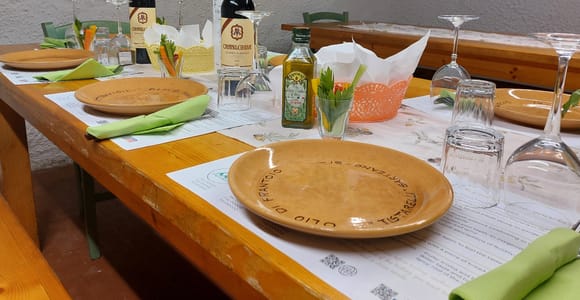
After the tour comes the tasting: usually two to four oils, with bread and sometimes a few cured meats, cheeses or vegetables. Some estates add a walk in the olive grove and a lunch. The price, usually €20–60 for a visit and tasting, rises to around €80–150 with lunch or a transfer from Florence. There is no official price list: each estate sets its own.
Out of season the route is the same, but with the machines switched off. When you book, ask whether the mill will be running: that is the question that changes the visit.
The labels: Toscano IGP and Chianti Classico DOP
The words "extra virgin" on a bottle don't tell you where the olives come from. The designations do.
| Toscano IGP | Chianti Classico DOP | |
|---|---|---|
| Area | the whole of Tuscany | only the Chianti Classico area, between Florence and Siena |
| Protected | since 1998 | since 2001 (consortium founded in 1975) |
| Supply chain | picking, pressing and bottling in Tuscany | all production within the area |
| Controls | chemical analyses and tasting panels | the DOP production rules |
| What to look for on the label | the word IGP and the State Mint (Poligrafico) seal | the words DOP Chianti Classico |
Toscano IGP is the most widespread designation. The consortium certifies the whole supply chain in the region with laboratory analyses and panel tastings. The label may add a geographical mention, such as Colline di Firenze, Colline Senesi, Colline di Arezzo or Seggiano. A new seal from the Italian State Mint (Poligrafico dello Stato) with a QR code has recently appeared on bottles.
Chianti Classico DOP is the oil of the Black Rooster area. The consortium that protects it has existed since 1975 and is now part of the same system as Chianti Classico wine. Tuscany also has other, more local DOPs: if you see one on a label, the origin is even more tightly defined.
Beware of vague wording such as "Tuscan oil" with no designation, or "produced in Italy" with a landscape of cypresses on the bottle. Without IGP or DOP you have no guarantee about where the olives were grown.
How to taste olive oil
Professional tasters use blue glasses, because colour says nothing about quality and can sway your judgement. At the mill you will be given bread or a small glass, and that is fine too. The method is simple.
- Warm it. Hold the glass in your palm, covered with your other hand, for half a minute: the warmth releases the aromas.
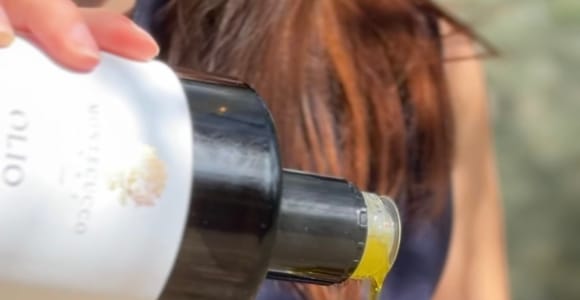
- Smell it. Look for cut grass, artichoke, green tomato, almond. An oil that smells of little, or worse of damp cellar, rancidity or mould, has a problem.
- Sip and draw in air. Hold a sip in your mouth and suck air in through your teeth: this spreads the oil across your palate.
- Judge the bitterness and pepperiness. Bitterness is felt on the tongue; the peppery kick reaches your throat a few seconds later and sometimes makes you cough. In new Tuscan oil both are strong, and both are virtues: they point to fresh olives rich in polyphenols.
- Clean your palate between oils with a slice of green apple or a sip of water.
Compare at least two oils, ideally from different areas or years. It is the quickest way to work out what you like before you buy.
Olive oil tours sold on the platforms
The olive oil visits bookable online are on GetYourGuide: the choice is small but sensible, with low prices and high ratings, and they are nearly always family-run businesses.
Olive Oil Mill Tour & Tuscan Food Tasting - Sarteano,Tuscany
(40 reviews) from €29
Book on GetYourGuide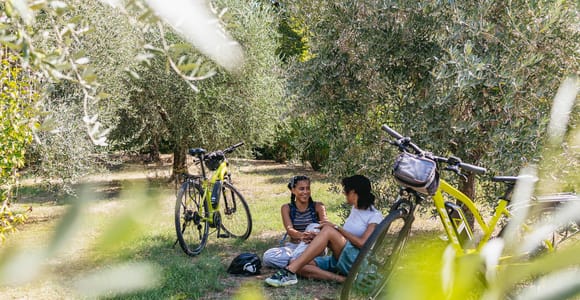
Florence: E-Bike Tour with Olive Oil in the Tuscan Hills
(230 reviews) from €55
Book on GetYourGuide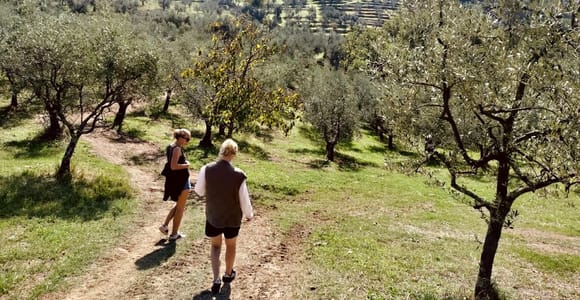
- Family-run mill near Siena: from €35, an hour and a half. A good choice if you are staying in Siena or in the Sienese part of Chianti.
- Sarteano: from €29, an hour and a half with tastings of local produce. Sarteano lies between Chiusi and Montepulciano, so it is handy if you are in the Val d'Orcia or the Valdichiana.
- Fiesole by e-bike: from €55, two and a half hours in the hills above Florence with an oil tasting. It is the only option that starts right in the city; the e-bike makes the climbs manageable even if you don't cycle often. For other bike rides, see cycling, Vespa and horseback riding.
- Montecatini Terme: from €40, two hours in the olive grove with a tasting. It combines well with half a day at the thermal baths.
- There is also an olive oil museum with a mill and an interactive route from €20, for those travelling with children.
Partner platform prices change and we check them regularly. As with wine, a visit booked directly with the estate may cost less: it is worth emailing or phoning, especially in November.
If you would rather have wine with a taste of oil on the side, the tours from Florence are on the wine tours page. Chianti farms almost always put their own extra virgin oil on the table next to the wine glasses.
All experiences in Tuscany on GetYourGuide
Buying olive oil in Tuscany outside the tours
Many large wine estates also make oil and sell it in their shop. Castello di Brolio, at Gaiole, has 26 hectares of olive groves next to 240 of vineyards. The Abbey of Sant'Antimo, near Montalcino, sells the monastery's oil. In both cases you can buy the oil without taking a guided tour.
During the harvest months you only need to drive through the hills of Chianti or the Val d'Orcia to see "frantoio" and "vendita olio nuovo" (new oil for sale) signs along the road. Many mills also sell over the counter to passers-by, often in 3- or 5-litre tins. The price of a tin at the mill is usually fairer than that of the bottles in central Florence.
Taking olive oil home
On a plane
Oil is a liquid. Airport security rules on liquids in hand luggage normally allow only small containers inside a clear bag: a half-litre bottle won't get through the check. Some airports with new-generation scanners apply different limits, but don't count on it: rules vary between airports and airlines. Check your departure airport's website before you pack.
The practical solution is the hold:
- choose tins over glass bottles: they weigh less and don't break;
- if you take glass, tape the cap shut, put each bottle in a sealed plastic bag and wrap it in clothes or a padded sleeve;
- think about the weight: three litres of oil in bottles weigh more than three kilos;
- many mills and shops ship to your home, and for large quantities that is often the simplest choice.
Customs
Within the European Union, oil for personal use travels without problems. If you are returning to a country outside the EU, check the food import limits of the country you are arriving in, and if in doubt, declare what you are carrying.
Mistakes to avoid
- Booking an olive mill visit in June and expecting to see the pressing. The machines stop when the season ends, usually by December.
- Buying "Tuscan" oil with no designation. Without IGP or DOP the origin of the olives is not guaranteed.
- Misjudging the pepperiness. That tickle in the throat is not a fault: it is the signature of fresh oil.
- Keeping oil in the light. In a shop window, in the sun or next to the hob it oxidises quickly. Choose dark bottles or tins.
- Turning up unannounced in November. It is the busiest month of the year: a phone call the day before saves you finding everyone busy with the olives.
Related pages
Olive oil goes well with other autumn experiences: truffle hunting, which in the same months enters the height of white truffle season, and cooking classes on a farm. For an overview of what to do in the region, start with experiences in Tuscany.