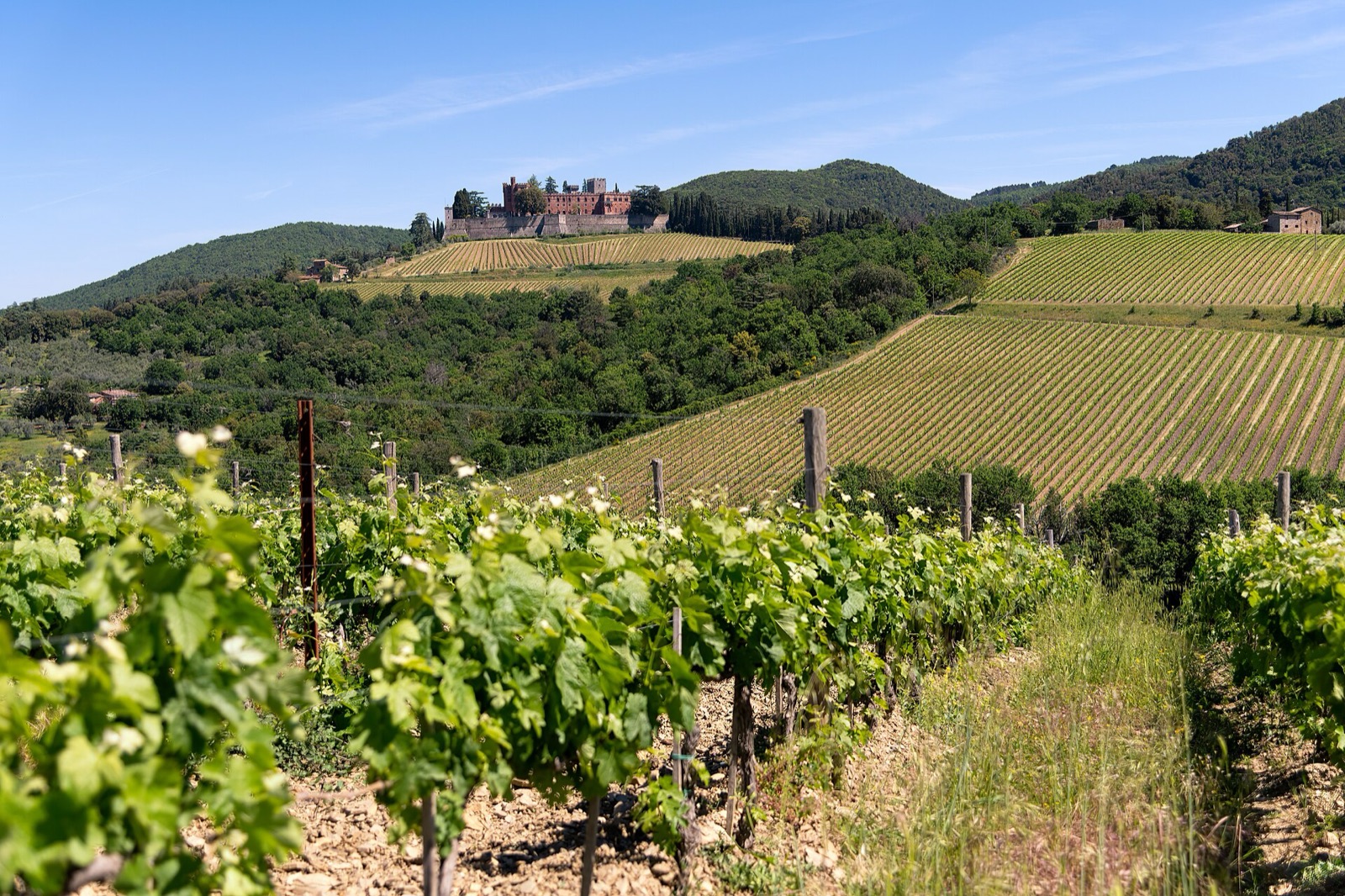
In short: how to plan Chianti
The Chianti villages are small, and almost everything worth doing lies outside them, at wineries scattered among woods and gravel roads. So the first decision is not where to go but how you will get around.
- You have one day, you are in Florence and you don't want to drive: a half-day organised tour with two wineries. It is the simplest option and the cheapest way to actually taste.
- You want to choose the wineries yourself: hire a car, book two visits at most (one in the morning, one in the afternoon) and decide in advance who drives and stays sober.
- You want to see a village and have a glass without any worry: bus 365 to Greve, lunch on the square, a tasting at a wine shop in the village, and back.
Tour formats, from half-day trips to private tours, are compared on the page about Tuscany wine tours and tastings.
The Chianti Classico area and the Chiantigiana
According to the Consorzio Vino Chianti Classico, the production area covers about 70,000 hectares across the provinces of Florence and Siena. It includes the whole of the municipalities of Greve, Castellina, Radda and Gaiole, all of them "in Chianti", and parts of San Casciano in Val di Pesa, Barberino Tavarnelle, Castelnuovo Berardenga and Poggibonsi. Every stage of production, from harvest to bottling, must take place inside it.
In 1716 an edict by Grand Duke Cosimo III de' Medici set the boundaries of the "Chianti" of the time, which matches today's Classico area. The Consorzio presents it as the first wine region in the world to be defined by law.
The backbone is the SR222, the Chiantigiana, which runs south from Florence to Siena through Greve, Panzano and Castellina. It is a hill road with plenty of bends: allow more time than your satnav promises. Radda and Gaiole lie further east, on minor roads that branch off the 222.
The Consorzio also recognises 11 UGAs, the "additional geographical units" that divide the area into sub-zones: San Casciano, Greve, Montefioralle, Lamole, Panzano, San Donato in Poggio, Radda, Castellina, Gaiole, Castelnuovo Berardenga and Vagliagli. For now the UGA name may appear on the label only on Gran Selezione.
The villages: Greve, Panzano, Radda, Castellina, Gaiole
Greve in Chianti
It is the village closest to Florence and the only one that is really convenient by bus. Its centre is the large market square, right on the Chiantigiana. It makes a good base if you don't have a car: wine shops on the square, a few wineries within a taxi ride and bus 365 to get back. The Castello di Verrazzano is a few kilometres away.
Panzano in Chianti
It is a hamlet of Greve, a few kilometres further south on the 222, and a UGA in its own right. The village is small and quick to walk round: the reason to stop is the vineyards and wineries around it. Bus 365 stops in Piazza Campana.
Radda in Chianti
This is where the Consorzio was founded on 14 May 1924; it describes itself as the first wine consortium in Italy. The former convent of Santa Maria al Prato houses Casa Chianti Classico, the visitor centre devoted to the wine, run by private operators rather than by the Consorzio: it offers sensory trails, tastings and lunches, but opening hours change often, so check them before you go.
Castellina in Chianti
It is the village closest to Siena along the Chiantigiana, and the natural stopping point if you arrive from the south or combine Chianti with Siena and San Gimignano.
Gaiole in Chianti
This is the home of L'Eroica, the vintage bicycle ride on gravel roads that started here in 1997 with 92 riders and takes place on the first weekend of October. The village also has Casa Eroica, the permanent museum. The municipality of Gaiole is home to the Castello di Brolio, the most spectacular visit in the area. If you want to cycle in Chianti, the details are on the page about bike and Vespa tours.
Chianti or Chianti Classico? And the Black Rooster
It is the most common misunderstanding, and it matters when you order at a restaurant. "Chianti" and "Chianti Classico" are two different wines, with two sets of production rules and two consortia.
- Chianti Classico DOCG is made only in the historic area described above. It must contain at least 80% Sangiovese and can go up to 100%. White grapes have been banned since 2006: the rest may come from authorised red varieties, native ones such as Canaiolo, Colorino and Malvasia Nera or international ones such as Merlot and Cabernet. It has been a DOCG in its own right since the decree of 5 August 1996; before that it was a sub-zone of Chianti.
- Plain Chianti DOCG covers a much larger area around the Classico zone, with a lower minimum Sangiovese threshold (usually 70%) and seven sub-zones: Colli Aretini, Colli Fiorentini, Colli Senesi, Colline Pisane, Montalbano, Montespertoli and Rufina.
Only Classico carries the Black Rooster (Gallo Nero), the seal with the black cockerel on the neck or back label of the bottle. If it isn't there, it isn't Chianti Classico.
Within Classico, the Consorzio sets out three levels:
| Type | Grapes | Minimum ageing | Minimum alcohol |
|---|---|---|---|
| Annata | at least 80% Sangiovese | 12 months | 12% |
| Riserva | at least 80% Sangiovese | 24 months, including 3 in bottle | 12.5% |
| Gran Selezione | at least 90% Sangiovese, the rest native red varieties only | 30 months, including 3 in bottle | 13% |
Gran Selezione was created in 2014 and is made only from estate-grown grapes. Many articles still quote the old rule, which allowed 80% Sangiovese and international varieties. The 90% threshold is being phased in gradually: a bottle already on sale may still follow the previous rule.
The legend of the Black Rooster
It is a legend, not history, but the Consorzio itself tells it. To settle the border between Florence and Siena, two knights were supposedly to set off from their cities at the first cockcrow, and the border would lie where they met. Siena chose a white rooster, Florence a black one, which it kept shut in the dark and nearly starved. Hungry, the bird crowed long before dawn, and the Florentine knight set off early. The two met at Fonterutoli, just 12 kilometres from Siena, and almost all of Chianti went to Florence. The black rooster was the emblem of the military League of Chianti, and Vasari painted it on the ceiling of the Salone dei Cinquecento in Palazzo Vecchio in Florence.
Four wineries you can visit
All of them are visited by booking. Prices are the ones published by the estates where they exist; otherwise they are indicative.
Antinori nel Chianti Classico (Bargino, San Casciano in Val di Pesa). This is the modern winery with the spiral staircase and the vineyard on the roof. The Tinaia Tour lasts about an hour and a half, in a group, in Italian or English, and ends with three wines. On the official website it costs €50 for an adult, €10 up to age 17, and is free up to age 6. You pay by card when you book and it is non-refundable. Some guides still quote €45: that is the old price.
Castello di Brolio – Barone Ricasoli (Gaiole). It is the largest estate in Chianti Classico: 1,200 hectares, of which 240 are vineyards and 26 olive groves. The castle and garden open every day in season, usually from late March to December, with shorter hours in autumn; check the calendar on the official website. Tastings, such as the one in the Limonaia with three wines and entry to the garden, generally cost €35–50 and are booked on the estate's website.
Castello di Verrazzano (Greti, Greve). It is the birthplace of the navigator Giovanni da Verrazzano, a few minutes from Greve. There is a classic visit with tasting, which reviews put at between €20 and €30, and a three-hour visit with gardens, historic cellars, four organic wines, Vin Santo and a full lunch: for current prices, ask the winery on +39 055 854243. The rules are clear: free cancellation up to the day before, 20% if you cancel on the day or don't turn up. There are stairs in the cellars, and wheelchair access is difficult.
Badia a Passignano (Barberino Tavarnelle). Beneath a Vallombrosan abbey lie cellars about a thousand years old, now owned by Antinori. The guided visit is by booking only and ends with the Badia's Gran Selezione. There is also a wine shop, a cookery school and the Osteria di Passignano, which has a Michelin star. The price of the visit is not published: ask when you book.
Many more estates are listed in the Consorzio's directory, and the Chianti Classico Card gathers bookable experiences at several wineries. For the local olive oil, a PDO since 2001, see the page on olive oil.
Organised tours from Florence
If you don't want to drive, group tours are the cheapest way to see two wineries in half a day. Tiqets sells a guided visit with tasting from €45 and a trip of about five hours with an estate visit from €89. On GetYourGuide the most-reviewed winery tour starts from €49.50. From Siena there is a Chianti castles tour with tastings from €85. Partner prices change often and we check them regularly.


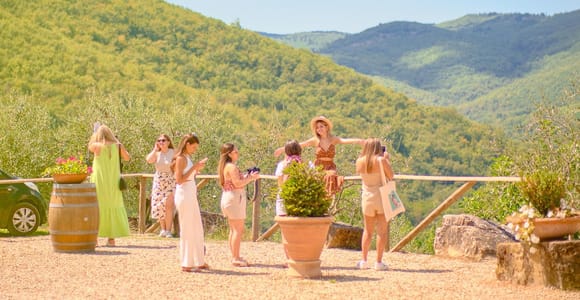
The drawback is choice: the operator picks the wineries and there is little time in the villages. Small-group, private, bike and Vespa formats are compared on the page about wine tours. If you want to see the vineyards from above, sunrise flights taking off from Chianti are on the page about hot air balloon flights.
All Chianti tours on GetYourGuide
Getting there without a car: bus 365
Autolinee Toscane line 365 links Florence with Greve and, on some variants, with Panzano, Radda and Gaiole. In Florence it leaves from the Piazzale Montelungo hub, next to Santa Maria Novella station. The useful stops are Greve Parcheggio, Greve Piazza Trento and Panzano Piazza Campana.
- Florence–Greve takes about 50–60 minutes.
- On weekdays there is roughly one bus an hour; on Sundays and public holidays far fewer.
- Several services run only on school days: they are marked as school services on the timetable.
- Diversions for roadworks in the city happen on this line: check the notices before you set off.
Check the timetable on at-bus.it or on the Autolinee Toscane app; the freephone number is 800 14 24 24. The fare depends on distance: check it when you buy. From Siena, line 125 goes to Castellina and Radda. Once in the village, wineries outside the centre are usually reached by taxi or on foot.
By car: the drink-drive rules
In Italy the general limit is 0.5 grams per litre. For some people, though, it is zero: anyone under 21, anyone who has held a car licence for less than three years and anyone driving for work. New drivers are the most exposed, because a single sip is enough to go over zero. Following the recent reform of the Highway Code, penalties are tougher, and anyone convicted of drink-driving must have an alcohol interlock fitted.
With three or four wines per tasting, two wineries in the same day can easily take you over 0.5. The practical solutions:
- a tour with a driver, group or private;
- a designated driver who doesn't drink;
- the spittoon: using it at a winery is perfectly normal;
- sleeping in Chianti and visiting a single winery on foot from where you are staying.
Mistakes to avoid
- Too many wineries in one day. Two is the sensible maximum; with three you enjoy none of the visits.
- Turning up without a booking at the large estates between April and October.
- Getting the glass wrong. In a restaurant "a Chianti" can be almost anything: if you want Classico, look for the Black Rooster.
What to combine with Chianti
Chianti sits in the middle of everything: Florence to the north, Siena to the south, San Gimignano to the west. Further south, beyond Siena, lies the Val d'Orcia, with Brunello di Montalcino and Vino Nobile di Montepulciano. For other trips from Florence see the day trips page, and for the body that protects the wine there is our page on the Chianti Classico Consorzio.