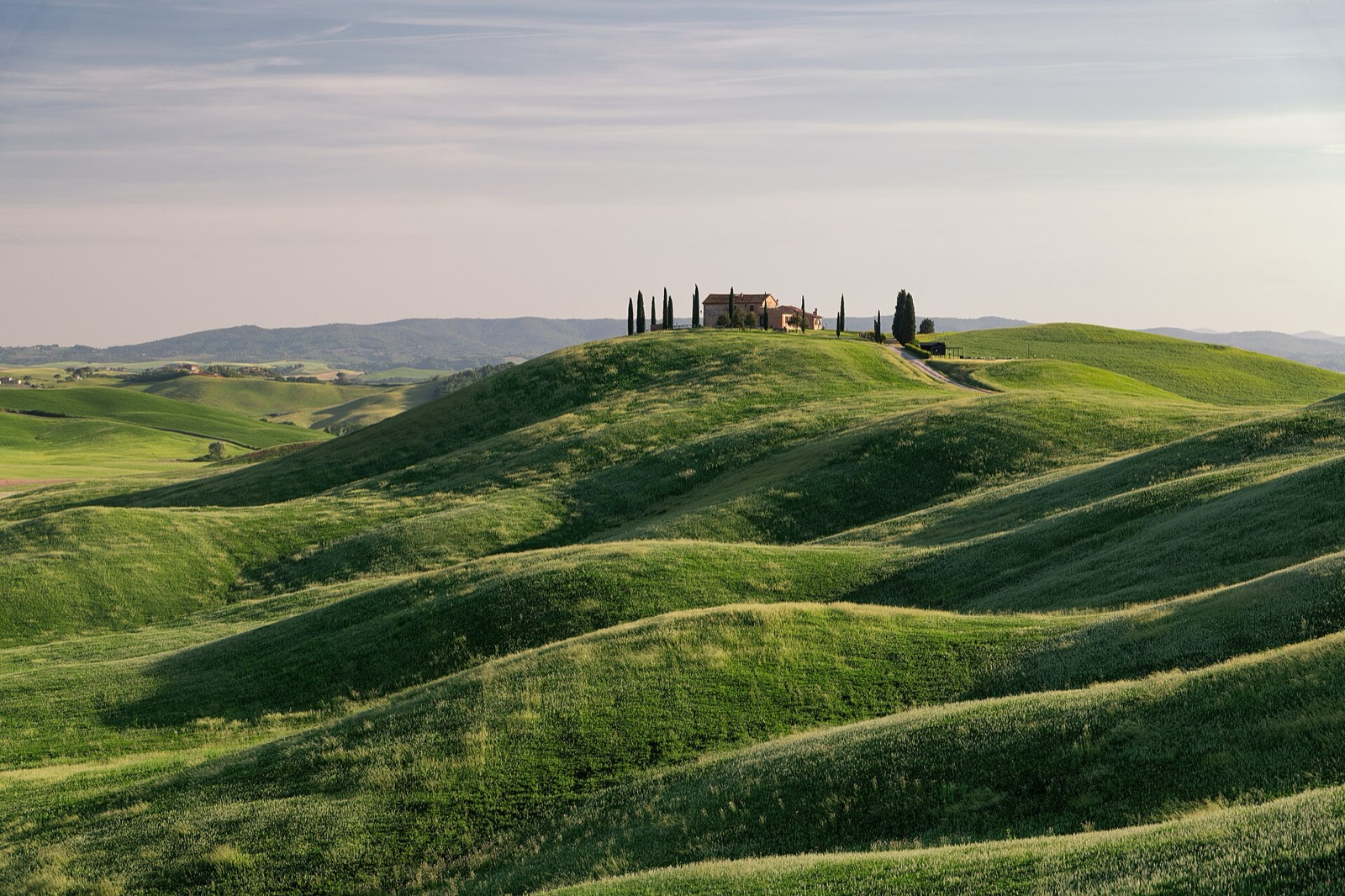
Tuscany in a few lines
Tuscany has ten provinces, about 3.66 million inhabitants and a variety that tends to get lost in the guidebooks: art cities, vine-covered hills, walled hill towns, two very different stretches of coast, islands and free thermal waters. Massa-Carrara, which many people count as two provincial capitals, is a single province with its seat in Massa. Offshore lies the Tuscan Archipelago, from Elba to Giglio.
There are eight UNESCO sites. Seven lie entirely in Tuscany:
- the historic centre of Florence (since 1982);
- the Piazza del Duomo in Pisa (1987);
- San Gimignano (1990);
- Siena (1995);
- Pienza (1996);
- the Val d'Orcia (2004);
- the Medici villas and gardens (2013).
The eighth is Montecatini Terme, part of the transnational site of the Great Spa Towns of Europe. Lucca, Volterra and Elba, which often turn up in these lists, are not UNESCO sites. The Cinque Terre are, but they are in Liguria.
How to plan a trip to Tuscany
There are three possible approaches, and the choice depends mostly on how you get around.
Base yourself in Florence. This is the right choice if you are travelling without a car. Regional trains leave Santa Maria Novella for every provincial capital at fixed fares: Pisa costs €9.80 and takes about an hour, Lucca €8.90 and an hour and twenty minutes, Arezzo €9.80 and about an hour. The bus station of Autolinee Toscane, the only company that runs all the buses in the region, is a few steps away. The drawback is that the city is expensive: the tourist tax ranges from €3.50 to €8 per person per night depending on the hotel category, the highest in Tuscany.
Base yourself in Siena. This makes sense if the trip is heading south: Chianti, the Val d'Orcia, Montepulciano and the Crete. Buses leave Siena for Montalcino, Pienza and Montepulciano, and the express bus to Florence takes about 75 minutes. In the evening the tour groups leave the centre and it is pleasant to walk around.
A road trip by car. This is the only way to see the countryside, the free hot springs and the Maremma properly, since buses there are few and often run only on school days. The practical rule: a car is very useful between villages and a problem inside the cities. Florence, Siena, Pisa, Lucca, San Gimignano, Montepulciano and Pienza have a ZTL (a limited traffic zone) or pedestrian centres with cameras, and every unauthorised entry can cost a fine of €83 to €332. Park outside the walls. If you are staying in the centre, ask the hotel to register your number plate and confirm how long in advance they need to do it.
When to go
The best months are May, the first half of June, September and the first half of October. In Florence the average highs are 24 °C in May and 27 °C in September. In July and August temperatures in the city's basin go above 32 °C, with frequent heatwaves. November is the wettest month. Winter is mild in the cities and quiet in the museums, but cold and foggy in the hills.
- January: not recommended or closed
- February: not recommended or closed
- March: good
- April: good
- May: best time
- June: best time
- July: good
- August: good
- September: best time
- October: best time
- November: good
- December: not recommended or closed
best time good not recommended or closed
In Florence, average highs in July and August are above 32 °C; November is the wettest month. In winter the queues are short, but the hill towns are cold and often in fog. The grape harvest runs through September and October, and the new olive oil arrives in November.
Some dates change the whole trip. The Palio di Siena is run on 2 July and 16 August. Pisa has the Luminara on 16 June and the Gioco del Ponte on the last Saturday of June. Florence's Calcio Storico is played in Piazza Santa Croce in June, with the final on the 24th. Lucca Comics & Games fills Lucca for a few days around 1 November. The Viareggio Carnival parades on several days between late January and February; the dates shift with Easter. If the event interests you, book early; if it doesn't, avoid those dates.
The map of Tuscany
Area by area
Here is the summary; each area has its own page with prices, opening times and transport.
Florence
This is where almost everyone starts: the Uffizi, the Accademia, the Duomo dome and a network of trains and buses to the rest of the region. Our page on Florence treats it as a base for Tuscany; for the organised trips that leave from there, see the page on day trips.
Pisa, Lucca and the northern coast
Pisa can be seen in half a day, and the Tower is booked on the site of the Opera della Primaziale. Lucca, half an hour by train from Pisa, is explored on foot or by bike along the walls. Further north is Versilia, with Viareggio and Pietrasanta, and beyond it the marble quarries of Carrara. The Cinque Terre are just over the border in Liguria and easy to reach by train.
Siena, San Gimignano and the borghi
Siena needs at least a day for the Duomo complex, the Campo and the Torre del Mangia. San Gimignano pairs well with Siena and Monteriggioni. For Certaldo, Pitigliano, Anghiari and the other borghi, the hill towns and villages, there is a page on the borghi; for Elba and Volterra, see the page on Volterra and Elba.
Chianti and the Val d'Orcia
Chianti lies between Florence and Siena: hills, castles, wineries. Further south the Val d'Orcia brings together Pienza, Montalcino, Bagno Vignoni and, just outside it, Montepulciano. For organised tastings, see the page on wine tours.
Arezzo, Cortona and eastern Tuscany
Arezzo and Cortona are on the railway line to Rome. Arezzo has Piero della Francesca's fresco cycle, which you visit by booking at least three working days ahead, except on the first Sunday of the month, when it is free and needs no booking.
The Maremma, the spas and the south
The Maremma is the least crowded part of Tuscany: the Cascate del Mulino at Saturnia, the Alberese park, Cala Violina, the Tarot Garden. The other free springs and the paid thermal parks are on the page about thermal baths. If you are coming from the capital, read the page on Tuscany from Rome.
Experiences
Beyond the places there are the activities, grouped by theme: cooking classes, truffle hunting, hot-air ballooning, olive oil and mills, bikes, Vespas and horses, outlets, exhibitions and, for families with children, caves, parks and the aquarium. The full list is in things to do in Tuscany; our own ranking is the top 10.
How we choose tickets
We earn a commission when you buy a ticket or a tour through Tiqets, our main partner, or GetYourGuide. This does not change the way we write our pages, for three reasons.
- The official price always comes first. For every museum or monument we name the body that runs it, its website and the price it publishes. In Pisa, for example, the Tower and the Duomo cost €20 on the Opera della Primaziale's site, and you can change the time or cancel up to 2 hours beforehand. The same ticket on Tiqets starts from €25 and is non-refundable. We say so as it is.
- We say when the partner makes sense. That happens when the official slots are sold out, when you want a guide the official body does not offer, or when the problem is transport: a day trip from Florence to Siena and San Gimignano, a Chianti tour with a driver, a hot-air balloon flight. In these cases we compare the offers on length, content, reviews and cancellation terms, not just on price.
- No fake savings. Some platforms calculate the discount against a "full value" higher than the official price. When that happens, we point it out.
Partner prices change often: we check them regularly, but the price you see at the moment of purchase is the one that counts. The official rules, such as minimum ages, closing days and time slots, come from the websites of the bodies concerned. When a source is unclear, or two sources disagree, we say so on the page and tell you where to check.
Tuscany day trips and experiences on Tiqets
Operator reviews
Before paying, it helps to know who is behind a ticket or a tour. In our operator reviews we assess the platforms, such as Tiqets and GetYourGuide, the agencies that run day trips from Florence, and the official bodies, such as the Opera della Primaziale Pisana and the Opera della Metropolitana di Siena. For each one you will find what it sells in Tuscany, how cancellations and customer support work, what customers praise and complain about, and who it suits.