Before you go: three things to know
What is UNESCO and what isn't. The Val d'Orcia has been a UNESCO World Heritage Site since 2004 as a cultural landscape: more than 61,000 hectares of farmed hills, farmhouses and villages. According to the Parco della Val d'Orcia, the site covers five municipalities: San Quirico d'Orcia, Castiglione d'Orcia, Pienza, Montalcino and Radicofani. The historic centre of Pienza is a UNESCO site in its own right, since 1996. Montepulciano is not in the site: it is in the Valdichiana, about ten kilometres east of Pienza. It is on this page because you visit it on the same trip, not because it belongs to the valley.
Without a car it is difficult. There are buses from Siena, but they are designed for students. The details are further down; in short, if you have only one day and you are in Florence, book a day trip.
One day is enough for a taste, not for everything. Distances look short on the map, but the roads are hilly and each village needs at least an hour. If you can, spend a night in the valley: at dawn and sunset the light changes everything, and there are fewer people about.
The villages, one by one
| Place | Why go | Worth knowing |
|---|---|---|
| Pienza | the Renaissance "ideal city", pecorino cheese | Palazzo Piccolomini charges admission |
| Montalcino | Fortezza, Brunello and Rosso | winery visits by booking |
| Montepulciano | Piazza Grande, underground cellars, tower | outside the UNESCO site |
| San Quirico d'Orcia | Horti Leonini, Via Francigena | bus 112 stop |
| Bagno Vignoni | the thermal pool that serves as a square | bathing banned |
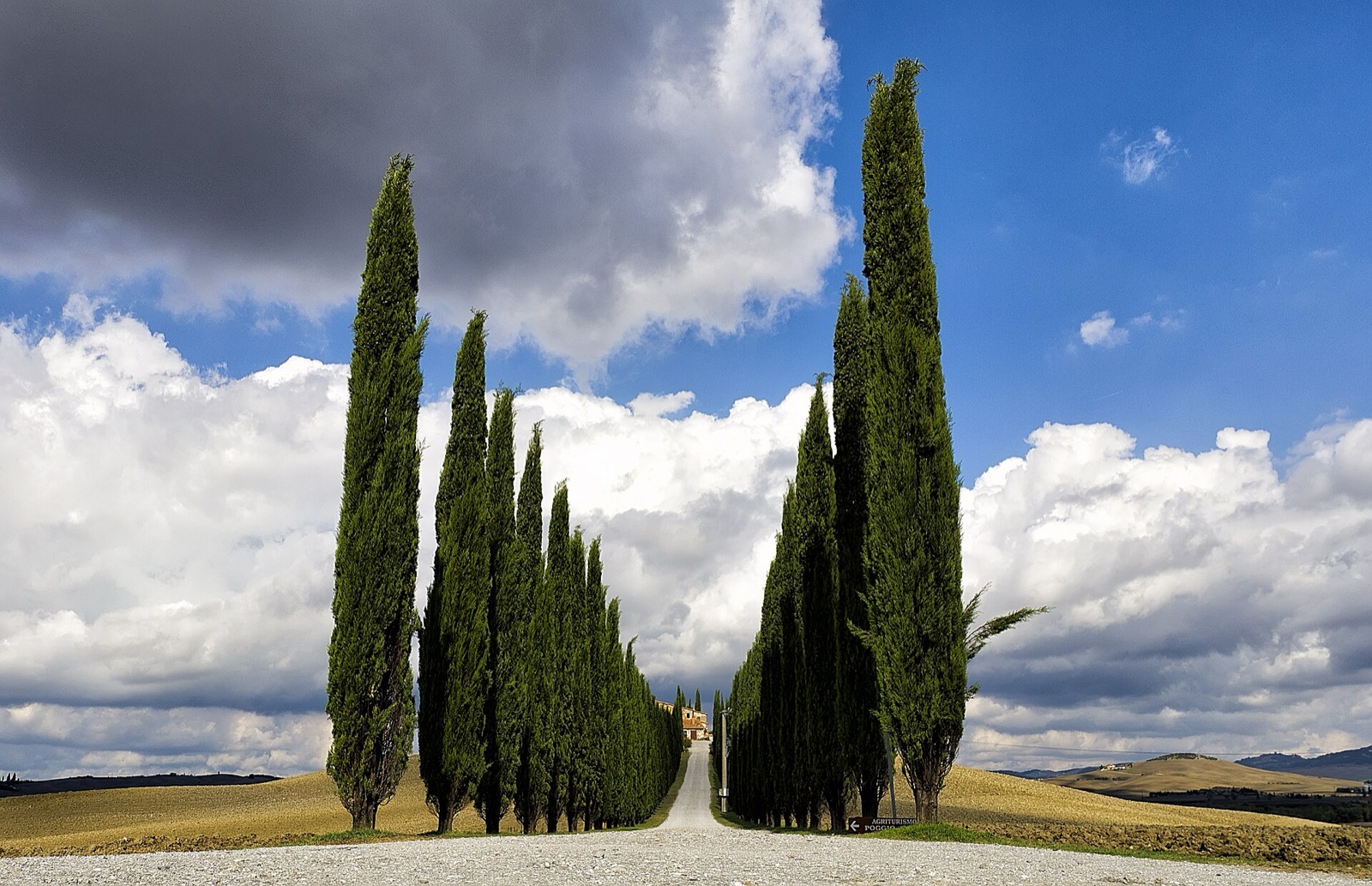
| Vitaleta | the chapel among the cypresses | private, seen from outside |
Pienza
Pope Pius II, Enea Silvio Piccolomini, elected in 1458, had his birthplace, Corsignano, rebuilt by the architect Bernardo Rossellino. Work around the trapezoid square now named after Pius II began in 1459: the Duomo, Palazzo Piccolomini, the Bishop's Palace (known as Palazzo Borgia) and the Palazzo Comunale. UNESCO considers it the first practical application of the Renaissance idea of the ideal city. Palazzo Piccolomini charges admission, and Tiqets sells entry from €10.
Pienza is famous for pecorino. Watch the labels: the protected name is Pecorino Toscano DOP, while "pecorino di Pienza" is a traditional and commercial name, not a DOP. The Fiera del Cacio cheese fair is usually held on the first Sunday of September.
Montalcino
The town is dominated by the Fortezza, built in 1361. The courtyard is free; for the walkways on the walls, guidebooks quote a ticket of around €4 (reduced €2), closed on Mondays, but there is no official page: check on the spot. Inside the Fortezza a wine shop sells Brunello and runs tastings. Since 2017 the municipality has also included San Giovanni d'Asso, with its castle and the Truffle Museum, in the Crete Senesi (see the page on truffle hunting).
There is a widespread mistake about Brunello di Montalcino: it is not true that it spends "five years in the barrel". The Consorzio's production rules require 100% Sangiovese, at least two years in wood and at least four months in bottle (six for Riserva). The wine cannot be sold before 1 January of the fifth year after the harvest, the sixth for Riserva. It must be bottled within the area and only in Bordeaux-style bottles. Rosso di Montalcino, also pure Sangiovese, is released much earlier, from 1 September of the year after the harvest, and it is the right wine if you want to taste without paying for a Brunello.
Montepulciano
Montepulciano is in the Valdichiana, but it is the stop almost nobody skips. Its wine is Vino Nobile di Montepulciano, based on Sangiovese, known locally as Prugnolo Gentile, usually at least 70%.
- Tower of the Palazzo Comunale. Usually open every day from 1 April to early November, 10:00–18:00 (last entry 17:45), weather permitting. The Comune lists €5 full price and €2.50 reduced or for the terrace only; free under 10. With the Museo Civico it costs €8 (€6 reduced). A lift takes you to the first two floors, then there are about 60 narrow, steep steps. On clear days you can see the Valdichiana, the lakes, Monte Amiata, Pienza, Montalcino and the towers of Siena. The ticket office and tourist office are on the first floor of the Palazzo (Pro Loco, +39 0578 757341).
- Museo Civico Pinacoteca Crociani, in Via Ricci: €6 (reduced €4), closed on Tuesdays.
- Underground cellars. At Contucci, in Piazza Grande, the visit of about two hours with one Rosso and three Nobile wines and a board of cold cuts and cheese costs €40, or €25 with just a few nibbles; it runs from 1 April to 6 January, on Mondays, Tuesdays, Fridays and Saturdays at 11:00 and 15:30, maximum 20 people, and must be booked at least 15 days ahead. At De' Ricci, with vaults carved into the tufa rock known as "the Cathedral", the visit with tasting is listed at around €20: ask for the current price.
- The Tempio di San Biagio, outside the walls: Tiqets sells entry from €8.
Twilight fans will know this already: the New Moon scenes set in Volterra were filmed here, in Piazza Grande. The Bravìo delle Botti is usually run on the last Sunday of August: the eight contrade (town districts) push an 80 kg barrel uphill for about 1.7 km, up to Piazza Grande.
San Quirico d'Orcia
It is a convenient base, a stop on the Via Francigena and served, like Pienza, by bus 112 (stop in Via dei Fossi). Worth seeing are the Horti Leonini, a Renaissance garden free to enter, and the Collegiata church. More details on the page about the borghi, the hill towns and villages.
Bagno Vignoni
A few kilometres from San Quirico, this village has a 16th-century thermal pool instead of a main square, Piazza delle Sorgenti, with water at around 38 °C. It is a protected monument and bathing is banned, as it is in the pools of the Parco dei Mulini below, where the water flows past medieval mills cut into the rock and forms small white travertine cascades. You can only dip your feet in the channels. For a proper soak there are the hotel spas, for a fee; the nearest free pools are at Bagni San Filippo, in the municipality of Castiglione d'Orcia. All the options are on the page about thermal baths in Tuscany.
Vitaleta and the film locations
The chapel of the Madonna di Vitaleta, among the cypresses, is in the municipality of San Quirico, not far from the SP146 road to Pienza. Park where the gravel track begins and walk about 10 minutes, 550–700 metres, along a white road closed to cars. It is on private land and is usually closed: you photograph it from outside. Also private are Podere Belvedere, the farmhouse with cypresses in the sunrise photos near San Quirico, and Podere Poggio Manzuoli, Maximus's farm in Gladiator: look at them from the road. The film's "Elysian Fields" were shot along the Terrapille road, about 3 km south of Pienza.
The abbeys: Sant'Antimo, Monte Oliveto and San Galgano
Sant'Antimo (Castelnuovo dell'Abate, municipality of Montalcino). Tradition links its founding to Charlemagne; the present Romanesque church dates from the 12th century. Entry to the church is free. Official hours: April to September daily 10:00–18:30, October 10:00–18:00, November to March 10:30–17:00, with entry on Sundays and public holidays only from 11:00, after Mass. For a fee there is "La Via della Luce", a route with a video guide that opens the Carolingian chapel, crypt, loggia, monastic pharmacy and garden. Many guidebooks still promise Gregorian chant by the canons: the community has changed, so don't count on it. Tiqets sells an entry from €8: since the church is free, check what it includes before you buy it.
Monte Oliveto Maggiore (Chiusure, municipality of Asciano). It is in the Crete Senesi, north of the Val d'Orcia, and fits well into the same day. It is open every day of the year, 09:30–12:20 and 14:30–16:40, closing at 17:40 in summer. Entry is usually free. The reason to go is the Chiostro Grande, the great cloister, with about 35 frescoes of the life of Saint Benedict painted by Luca Signorelli and then by Il Sodoma.
San Galgano is not in the Val d'Orcia: it is at Chiusdino, in the Val di Merse, about 30 km south-west of Siena, on the opposite side. If you put it in the same day as the Val d'Orcia, you lose hours in the car. On the Fondazione San Galgano website the All Inclusive ticket (abbey and the Chiusdino museums) costs €9, reduced €7; abbey plus one museum €8/€6. The abbey is open every day without a lunch break, from 09:00 until 18:00–20:00 depending on the season. The sword in the stone is in the Rotonda di Montesiepi, on the hill above the abbey, and is free to enter. The complex occasionally closes for special events: check the website before you set off.
The transport problem: buses 112 and 114
There is no direct bus from Florence to the Val d'Orcia. You first go to Siena (see Siena for train and bus) and from there take the Autolinee Toscane regional lines:
| Line | Route | Time from Siena |
|---|---|---|
| 114 | Siena – Buonconvento – Torrenieri – Montalcino | about 1 hour to 1 hour 15 |
| 112 | Siena – (Buonconvento – Torrenieri) – San Quirico – Pienza – Montepulciano | about 1 hour 15 to 1 hour 50 |
The problem is not the route but the timetable. On the published timetables most services are school services, meaning they run only on school days; there are only a few services a day and on Sundays there is almost nothing. During school holidays the school services disappear and a summer timetable applies, which you need to check separately. Between villages, for example from Pienza to Montalcino, and to Bagno Vignoni, Vitaleta or Sant'Antimo, there are in practice no connections. You can also reach Montepulciano by train to Chiusi-Chianciano Terme and then by bus, but check the connection before you set off.
Always check the timetable valid for that day on at-bus.it or by calling the freephone number 800 14 24 24, every day from 06:00 to midnight. A day in the valley without a car works for one village only, two at most on the same line.
A day by car from Florence
The itinerary below covers the highlights in one long day, starting early from Florence. Times are indicative. Montepulciano is left out: it deserves half a day of its own, perhaps the next day if you stay in the valley. The driver skips the tastings: the drink-drive rules are explained on the page about Chianti.
- Florenceset off by car towards Siena and the Crete Senesi
- Abbey of Monte Oliveto Maggioreopens at 09:30; the frescoed cloister needs an hour
- MontalcinoFortezza and old town; the driver doesn't taste
- Lunch in Montalcino or Castelnuovo dell'Abatebook at weekends
- Abbey of Sant'Antimochurch free, also open in the early afternoon
- Bagno Vignonithe pool in the square and the Parco dei Mulini; feet only in the channels
- San Quirico d'OrciaHorti Leonini, then the road to Pienza
- Vitaleta chapelpark on the road and walk 10 minutes on a gravel track
- PienzaPiazza Pio II, then the valley at sunset
- Back towards Florenceabout two hours' drive; or stay the night in the valley
Organised day trips and tickets
If you have only one day from Florence, a group day trip solves the transport problem. The Tiqets and GetYourGuide options last 11–12 hours, with Pienza, Montepulciano and often a tasting in Montalcino; you get an hour or a little more in each village. Tiqets starts from €82.80, GetYourGuide from €92. The Tiqets option with a tasting in Montalcino, from €159, has no reviews yet. Partner prices change often and we check them regularly.

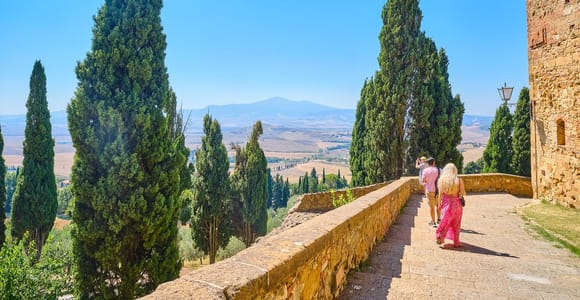
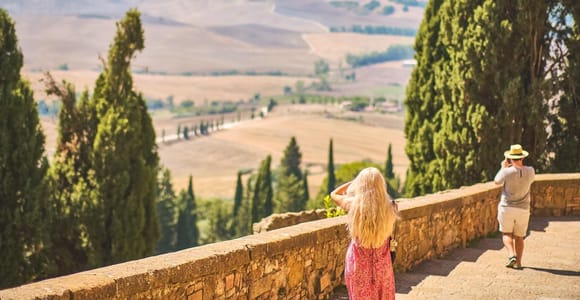
Florence: Montalcino, Pienza, Montepulciano & Wine Tastings
(429 reviews) from €92
Book on GetYourGuideIf you are already in the area with a car, Montalcino has short winery visits: on Tiqets a vineyard tour with tasting from €32.50, on GetYourGuide a tasting with lunch at a castle from €61.90. Palazzo Piccolomini can be booked in advance on Tiqets, but the ticket is non-refundable.

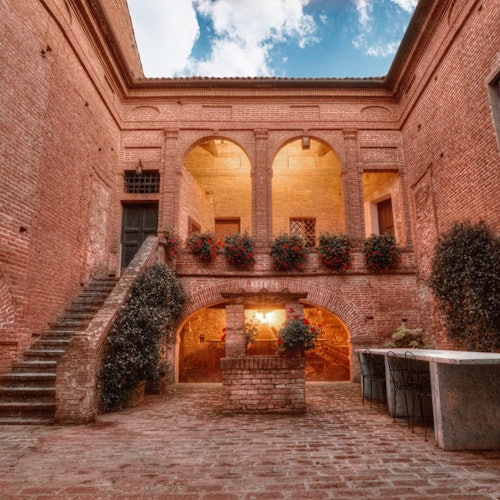
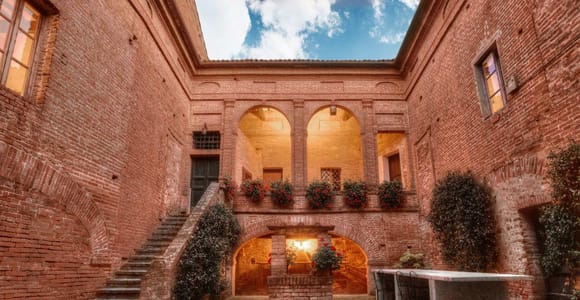
Montalcino: Brunello Wine Tasting & Lunch in a Tuscan Castle
(508 reviews) from €61.90
Book on GetYourGuideTo see the valley differently: a hot air balloon flight over Pienza and Montalcino from €350 (see hot air balloon), a horse ride through the Montepulciano vineyards from €85, or an e-bike tour from Montepulciano towards Pienza and Monticchiello from €78.
All Montepulciano activities on GetYourGuide
The comparison of wine tours, including those focused on Brunello, is on the page about Tuscany wine tours and tastings.
What to combine it with
The Val d'Orcia combines well with Siena, to the north, and with Arezzo and Cortona through the Valdichiana. For a free thermal soak, head towards the Maremma and Saturnia or to Bagni San Filippo. If you are coming from Rome, the valley is halfway: see the page on day trips from Rome.